The forecast is calling for overnight thunderstorms, sleet, and snow. There's still snow on the ground here.
Several of our patients at work have told me they've seen robins. I've heard birds who wintered over singing their spring songs -- especially chickadees! Yesterday, I saw a white-breasted nuthatch.
There is something pleasing about the relentlessness of spring's coming. It doesn't matter that there's snow on the ground, or what winter weather will happen this week.
Thursday, 13 March 2008


Sunday, 9 March 2008
Daylight Spending Time?
My understanding is that Benjamin Franklin was thinking about saving candles when he came up with daylight saving time. And while it turns out that nowadays we may be saving electricity by changing to DST, it also turns out we might be using more energy to heat and cool our homes. So yes, Daylight Saving Time saves daylight -- but not, necessarily, energy.
Interesting!
Links:
Interesting!
Links:
England 5: York
Another of our day trips was to York, where there was lots to see and do.
When we got off the train, we walked up the hill to the Cathedral. It's a beautiful space. (What an understatement.) We appreciated the open spaces, the stained glass windows (many with notes regarding who took responsibility for their preservation during WWII, or for their restoration over hundreds of years), the organ, the fact that it's a working faith community, the atmosphere in general... I really liked the fact that there was an atmosphere of worship that nonetheless welcomed tourists; that combination felt really nice. And the docents were lovely to visitors.
I particularly noticed the stained-glass window "sacred to the memory of the women of the empire who gave their lives in the European war of 1914-1918."

In general, the mix of old and new, historical and present-day, was much less awkward in the parts of England I visited than what I've experienced in the US. (And -- aside from places like the pueblos in Frijoles Canyon in New Mexico -- "old things" in Europe are definitely older than "old things" in the States!)
We took the dare of climbing to the top of the tower. I like taking pictures of spiral staircases, but the two staircases to the tower are closed, not open, so I did not get any nautilus-type pictures of the spirals. Given just how long the climb is, it's probably better that way: I couldn't tell how much further we had to go up. Down, of course, took much less time and effort...
The stairs up the tower are so narrow that you can't pass while on them. Therefore, they only let people up every half hour. Everyone who's going in that time slot goes up, and nobody else goes up til they've all come down.
There's a lovely stop in the middle, where you walk along the outside edge of the roof, over to the second set of stairs. Also a nice place for a picture.

Happily, there are chairs at the top for wimps like me... Actually, I can't claim wimpdom on this one: the docents recognized us later as folks who'd made the climb. "Are we so memorable?" I asked. "No," one docent answered, "we just haven't had many people go up today," in a (Britishly understated) tone of admiration.
We had a lovely lunch of Cornish pasties, which we ate outside in St. Helen's Square. Then we wandered around the old part of the city, including the Shambles.

From the Shambles, we walked to the other side of the old part of town and visited Clifford's Tower, the remaining part of the Castle of York. More stairs -- first, up to the tower, then, in the tower. As my wife pointed out to me, there was a theme to our day... However, I did get a partial spiral stair picture out of the climb.
After Clifford's Tower, we crossed the River Foss, one of York's two rivers, and walked along most of the remaining city walls. This was fun.
And then we had afternoon tea in a Tea Room. Hee. Yum. We had lovely tea, accompanied by divine sultana scones and a Yorkshire curd tart. This made me happy.
We discovered mention of the Quaker Meetinghouse in a tourist map's list of "places to eat your lunch out of the rain." I insisted we go find it, and find it we did. Friargate Meeting is a lovely place, and visiting it -- especially so unexpectedly -- was one of the highlights of my day. The warden was also very hospitable, and we were very glad we stopped in. The Meetingroom itself is a place with a deep sense of peace, and it was a centering experience for me to spend a few minutes there. As I said, a highlight.

The warden showed us a picture of the interior of the old Meetingroom -- destroyed in WWII? I don't quite remember -- and Arch Street Meeting in Philadelphia is a spitting image of it.
I felt very welcomed and at home among British Friends, when we worshipped in Manchester, and when we visited Friargate and Briggflatts.
After visiting Friargate Meeting, we dashed back up the hill to the Minster for choral evensong, which was beautiful. (The organ was amazing!) Beloved Wife noted with amusement the addition of scripture regarding earthquakes. She also clearly found evensong a centering experience, a good end to our day in York.
(My reaction, particularly coming right after being in the Friargate Meetingroom, was, "Thank you, Goddess, for making me a Quaker!")
We crossed the River Ouse at sunset, on our way back down the hill to the train station.

For more pictures of our day in York:
 |
| 2008-02 England 5: York |
Tuesday, 4 March 2008
England 4: Manchester & Alan Turing
One of our days in Manchester, I briefly visited the new Alan Turing Building at the University of Manchester, as well as the memorial to Alan Turing in Sackville Gardens.
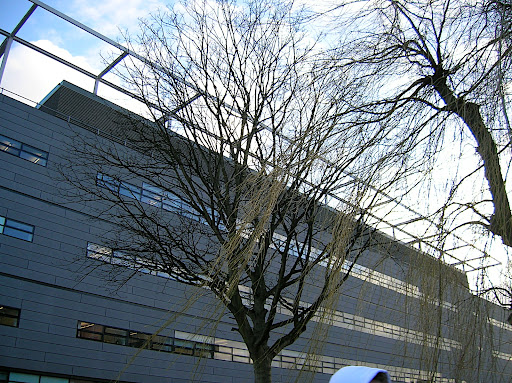


Alan Turing was a brilliant mathematician, cryptologist, and computer scientist in the first half of the 20th century. When he was discovered to be gay, he was arrested and convicted; lost his security clearance, his livelihood, and much of his participation in the world of mathematics; and was forced to undergo hormone treatments. Turing eventually committed suicide.
The statue in Sackville Gardens was dedicated in 2001. Not one major computer company contributed towards this memorial to the father of the computer and computer science.
Yet, he is honored in many other ways.
Still, his story gives me the chills...

Monday, 3 March 2008
England 3: Edale and Mam Tor (Heights of the Mother)
One of the first things I noticed in Manchester is what birdsongs I was hearing, and what birds I was seeing. The first of these was definitely the magpie, who seems to be a cheerful and sociable bird.

Our first day trip outside Manchester was to the town of Edale, in Derbyshire. It's in the Peak District National Park, halfway between Manchester and Sheffield. (Click here for the Ordnance Survey Map.) We headed south from Edale, up to Hollins Cross, then headed east (and further up!) towards Mam Tor. It was quite a climb! At the top, it was very, very windy; the closer we got to Mam Tor, the more the wind tried to knock us over. (My wife compared it to Mt. Washington in the White Mountains of New Hampshire in the US.)

The weather ranged from bright and sunny to cold and very windy, and everything in between, including (of course) a little rain. Somewhat like Michigan in that respect. We saw lots of sheep, and even a few cows. We also saw lots of gorse, and even a little heather, although none was in bloom until we got back down into town.
It was an amazing day spent out of doors, doing lots of walking. Our mileage wasn't actually as high as one might expect, but I was pretty proud of myself for doing as much as I did and under such conditions. I might not be up to what I used to be able to do before my injury, and my improvement might still be long and slow, but I can keep reminding myself that I am definitely improving... :)
 |
| 2008-02 England 3: Edale & Mam Tor |
England 2: Manchester
I worshipped with Friends in Manchester on 24th February, at Mount Street Meeting (Central Manchester Quaker Meeting). On the whole, I found British Friends very hospitable, both in Manchester as well as in York and Cumbria (more on those visits later).
We didn't make it to Pendle Hill, but I was nonetheless entertained by the name of the bus service we'd have taken if we had gone.

Spring is definitely further along there than in this part of the US; I have some pictures of crocuses, daffodils, and snowdrops (and later, a cherry tree in bloom).

More pictures from Manchester:
 |
| 2008-02 England 2: Manchester |
A trip to England
I've just returned from spending a week in the north of England, where my wife and partner is spending the semester. We were based mostly in Manchester, but took several day trips -- Edale, York, Cumbria/"Quaker country." I have lots of outdoorsy, nature-worship things to share, and also lots of neat Quaker historical things to share. I'm in the process of uploading pictures, and will add posts as I get my thoughts together.
Saturday, 1 March 2008
More on the First Amendment
It continues to blow my mind how so many people understand so little about the basics of the Constitution of the United States. And it continues to anger and frighten me how intolerant so many Americans are of religion other than their own.
School Board to Pay in Jesus Suit
School Board to Pay in Jesus Suit
Reducing our carbon footprints
Here's an interesting article from the New Yorker on the complexities of reducing carbon footprints. Is it better to grow something locally if it actually uses more energy and produces more greenhouse gases than growing it further away and transporting it? And other questions.
"Big Foot: In measuring carbon emissions, it's easy to confuse morality and science," by Michael Specter.
"Big Foot: In measuring carbon emissions, it's easy to confuse morality and science," by Michael Specter.
Barriers to local foods
Here's an interesting Op-Ed in the NY Times regarding the legal barriers to increasing production of local fruits and vegetables: "My Forbidden Fruits (and Vegetables)."
Wednesday, 20 February 2008
Total lunar eclipse
There's a total lunar eclipse tonight! Details, including diagrams for different time zones, are available on NASA's Eclipse page.
8:43 pm ET: partial eclipse begins.
10:01 pm ET: total eclipse begins.
10:51 pm: total eclipse ends.
12:09 am: partial eclipse ends.
8:43 pm ET: partial eclipse begins.
10:01 pm ET: total eclipse begins.
10:51 pm: total eclipse ends.
12:09 am: partial eclipse ends.
Local, Small-Scale Dairies
Here's an article in the NY Times about local, small-scale dairies. (Free registration required.)
I still remember the first times I had fresh, local milk and butter. Then I had really fresh eggs for the first time -- what an education. The eggs, like the milk and butter, were amazing, and far, far different from what I grew up on.
I still remember the first times I had fresh, local milk and butter. Then I had really fresh eggs for the first time -- what an education. The eggs, like the milk and butter, were amazing, and far, far different from what I grew up on.
Sunday, 10 February 2008
The Home Energy Saver Answer Desk
We recently got a programmable thermostat, something I've wanted for quite a while to save on our heating bill. When I asked our landlady, she and our handyman both thought it was a great idea, and they installed them in both units of our building last weekend.
I haven't had it long enough to know if I'll see an immediate difference in our heating bill, but I already love the convenience.
When I went looking to see if there are recommendations for actual temperature settings, I also found The Home Energy Saver Answer Desk.
The site has answers to common questions under the following headings:
~ General
~ Heating, Ventilation, and Air Conditioning
~ Comfort and Indoor Environment
~ Windows
~ Water Heating
~ Computers
~ Lighting
They include answers to all sorts of questions, including those niggling things like, if I turn my heat down to 55 F, does it take more energy to heat back up than it would if I'd left it at 65 F the whole time? (No -- go ahead, and "turn it down when you're not around.") Or, how much energy does my answering machine use vs my computer? (You'll be surprised.)
Anyway, it's a great resource for all sorts of everyday energy-use and energy-savings questions.
Enjoy!
Saturday, 9 February 2008
Executions in Nebraska
Good news: Nebraska's Supreme Court has outlawed use of the electric chair. For the AP newswire story, click here.
Friday, 8 February 2008
More on biofuels
National Public Radio's Talk of the Nation had a segment on Science Friday today on this very topic.
For more info, including links to this segment as well as to the NPR news story, click here.
For more info, including links to this segment as well as to the NPR news story, click here.
Biofuels deemed not environmentally friendly
I've long been dubious about the promise of biofuels, particularly ethanol (I have real concerns about corn, for example). There's an interesting article in today's New York Times about two studies which have just been released that indicate that biofuels are actually an environmental threat.
Click here for the article. (Free registration required.)
Click here for the article. (Free registration required.)
Thursday, 7 February 2008
Breaking the Silence Exhibit
Breaking the Silence Exhibit
Israeli Soldiers Talk about the Occupied Territories
Philadelphia
February 9-24
at the Rotunda
40th & Walnut, University City
Opening night reception: February 9 at 7 pm
Boston
March 1-16
Whitehead Center for International Studies, Cambridge
Opening night reception: March 1 at 7 pm
For more information, see http://www.breakingthesilenceexhibit.org/.
The reality of life on the West Bank and Gaza
In the summer of 2002, I went to Israel-Palestine for several weeks, as part of two different peace witness delegations. One of those was with Christian Peacemaker Teams, an organization I highly recommend.
I spent time in Jerusalem (especially Old City, which is beautiful and which I loved), Hadera, Megiddo, Jenin, Jenin Refugee Camp, Hebron, and Beit Ummar.
Hadera and Meggido are in Israel proper; Jenin, Jenin Refugee Camp, Beit Ummar, and Hebron are in what is commonly called "the West Bank" -- the Israeli-occupied West Bank of the Palestinian Territories. Jerusalem is on the edge of both Israel and the West Bank, and is primarily Israeli-administered.
(Two geography notes: 1: The West Bank of what?, I used to wonder. Of the Jordan River, with the country of Jordan to the east. 2: The other Occupied Palestinian Territory is the Gaza Strip, in the southwest, on the border with Egypt.)
One of the things I learned during my time in Israel-Palestine that summer is how little we Americans understand of daily life in the Occupied Territories. What we hear, read, and watch in the news bears little resemblance to the reality of life on the ground. There is, really, no way we can grasp it from what's available to us in the media.
Spending a little time living with Israelis in Israel, and then Palestinians in Jenin, Jenin Refugee Camp, Hebron, and Beit Ummar, I witnessed first-hand what life is actually like there -- in the West Bank, both for Palestinians and for Israeli soldiers. I made a commitment to share that reality when I returned to the States.
Why should we care what is happening in Israel-Palestine, any more than what happens anywhere else? Aren't there enough peacemaking opportunities right here at home? Enough hungry and homeless kids in our own cities? These were arguments I made when I found myself led to go half-way around the world. I had plenty to do in my own backyard in Philadelphia, thank you. And it always irritated me when people hared off to other places rather than paying attention and doing needed work right where they were.
But there are huge links between us here at home in the US and what happens in Israel and Occupied Palestine. My tax dollars, and yours, are one of the largest sources of external funding for the Israeli Defense Force. As Americans, we need to understand what is being done with our money and in our names.
There's an organization called Breaking the Silence, staffed primarily by volunteers who are former Israeli soldiers, which does work geared to helping ordinary Israelis understand that is happening in their backyard, in the West Bank and Gaza. They are now bringing their work to the US, to help ordinary Americans understand what's really happening.
Here's how I first learned of them:
personal blog entry, February 15, 2007
I was listening to the radio -- NPR's Day to Day -- on my way to work today, when I heard this piece on an Israeli organization called Breaking the Silence. Staffed by former Israeli Defense Force members, they offer tours to ordinary Israelis of the Israeli-controlled portion of Hebron, in the Israeli-occupied Palestinian territory of the West Bank [of the Jordan River].
Thank you, Goddess. When I was in Israel and Palestine, it was so clear that most Israelis had no idea what is going on in their names, no idea what the reality in the Palestinian territories is that accompanies the violence Israelis and Palestinians live with every day.
I am familiar with almost everything they presented in this story. I have walked through H2. I have walked down Shuhada Street. I still receive CPT updates about accompanying Palestinian children past the settlement on their way to school. I can't tell you how wonderful and refreshing it was to hear reality presented through more mainstream media.
I wish I could be in Philadelphia or Boston while their exhibit will be here. I encourage folks to attend.
Sunday, 3 February 2008
"What's the Matter"
This is stuck in my head; it's from the Catie Curtis song "What's the Matter":
What if I am Black or Jew
straight or queer or mother of two
run around in a hippie dress
ride my bike in a leather vest?
What's the matter?
Friday, 1 February 2008
It's not too late for MWG...
from FLGBTQC's Mid-Winter Gathering Planning Committee:
IT'S NOT TOO LATE... to register for the 2008 FLGBTQC Mid-Winter Gathering!!!
In 2008, the FLGBTQC Mid-Winter Gathering will take place February 15-18 in Maple Lake, Minnesota (near the Twin Cities). Not only will you get a chance to meet new friends and catch up with old ones, you'll also have opportunities to:
* Hear a plenary address by Wendy Sanford, one of the original authors of "Our Bodies, Our Selves"
* Eat wonderful meals
* Dance to music by Minnesota's best contra and square dance band, Pig's Eye Landing
* Sit in front of a fireplace (either in the main communal spaces or in any of the lodges)
* Listen to Canadian singer/songwriter/spoken word artist Evalyn Parry
* Attend workshops or activities
* Play in the snow (or NOT play in the snow, should you prefer)
* Hear Minnesotan Friend Anne Supplee share stories of courage from the Bible
* Participate in the FLGBTQC silent auction
* Sing around the piano
* Participate in Meeting for Worship with Attention to Business
* Bake cookies (and eat them, of course)
* Gaze at millions of stars (and maybe even some Northern Lights)
* Enjoy a bonfire
* ___________________ (Fill-in-the-blank with whatever YOU are bringing to share with others!)
There are still plenty of spaces remaining. Costs are only $175 per adult and $40 for anyone under 18 years old. Work grants and scholarship funds are available. Additional information and registration forms are online at http://flgbtqc.quaker.org/gatherings.html. Questions can be addressed to us through that website or by phone (John Skinner at 612-371-4769 or Nordis
Heyerdahl at 952-927-5765).
All are welcome to Mid-Winter Gathering. We hope you can join us!
Subscribe to:
Posts (Atom)


 Posts